
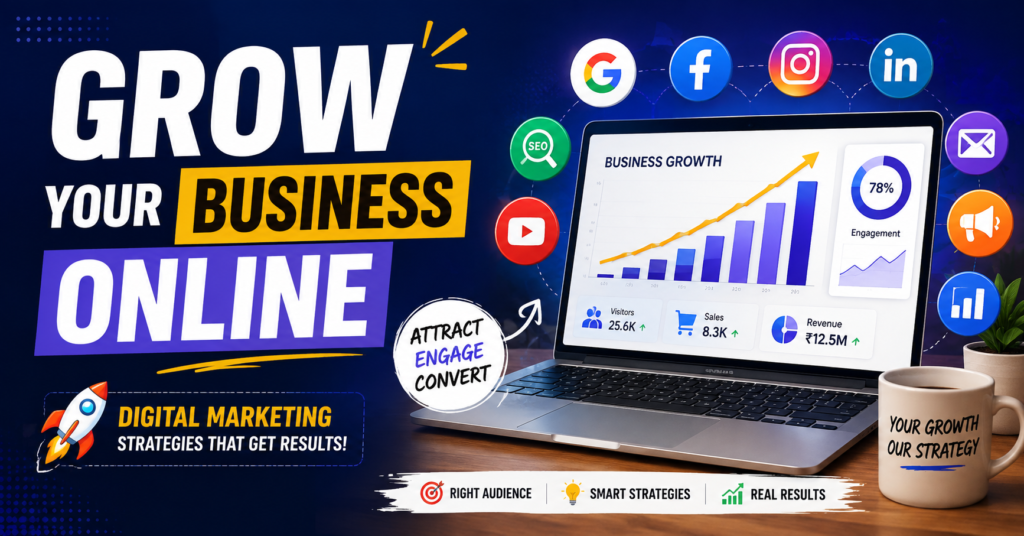
In a world where customers spend hours searching, scrolling, watching, and shopping online, having a strong digital presence is essential for every business. Whether you are a startup, freelancer, small business, or established brand, digital marketing can help you reach the right audience and grow your business online.
Moreover, as more customers move online, businesses must adapt to changing consumer behaviour. But what exactly makes digital marketing so powerful? Let’s explore.
What Is Digital Marketing and How Does It Work?
Digital marketing is the promotion of products, services, or brands through online channels such as search engines, websites, social media, email, and digital advertising.
Unlike traditional marketing, digital marketing allows businesses to reach specific audiences and measure how their campaigns are performing. As a result, businesses can understand their customers better and make more informed marketing decisions.
According to HubSpot, digital marketing includes multiple online strategies that work together to attract, engage, and convert customers.
Why Is Digital Marketing Important for Business Growth?
Imagine someone searching Google for a product or service that your business provides. If your website appears at the right moment, you have an opportunity to turn that search into a customer.
Furthermore, digital marketing can help businesses:
- Increase online visibility
- Reach a targeted audience
- Generate leads and sales
- Build brand awareness
- Connect with customers
- Track marketing performance
- Create long-term customer relationships
In addition, one of the biggest advantages of digital marketing is that businesses can analyze results and improve their strategies based on real data. Therefore, marketing decisions do not always have to rely on assumptions.
6 Key Types of Digital Marketing
1. SEO: Improve Your Search Engine Visibility
Search Engine Optimization (SEO) is one of the most important parts of digital marketing. It helps websites become more visible when people search for relevant information, products, or services online.
SEO focuses on improving your website so that search engines can understand your content and users can discover it through organic search results.
For example, keyword research, quality content, internal linking, website speed, mobile-friendliness, and a good user experience are all important areas of SEO.
Therefore, businesses that consistently follow good SEO practices can improve their chances of attracting organic traffic over time.
For beginners, Google’s official SEO Starter Guide is a useful resource.
2. Social Media Marketing: Build Your Online Brand
Social media platforms such as Instagram, Facebook, LinkedIn, and YouTube allow businesses to connect directly with their audience. As a result, brands can communicate with customers more personally and build stronger relationships.
From educational posts and reels to product demonstrations and customer stories, social media can help brands create awareness and build a community.
However, successful social media marketing is not simply about posting frequently. Instead, the content needs to be relevant, engaging, and valuable to the target audience.
For more information, you can explore social media marketing through Meta for Business.
3. Content Marketing: Attract Customers With Valuable Content
Blogs, videos, guides, infographics, newsletters, and social media content are all part of content marketing.
The goal is to answer questions, solve problems, educate customers, and build trust. In other words, businesses should focus on providing value instead of constantly promoting their products.
For example, a skincare brand could publish a blog about skincare routines rather than only promoting its products. Consequently, helpful content can attract potential customers and keep them connected with the brand.
Learn more about Content Marketing from the Content Marketing Institute.
4. PPC Advertising: Reach Your Target Audience Faster
Pay-Per-Click (PPC) advertising allows businesses to display paid advertisements on platforms such as Google. Unlike organic marketing methods, PPC can provide businesses with faster visibility when campaigns are properly planned.
Businesses can target specific keywords and audiences and pay when someone interacts with their advertisement.
However, simply spending money on advertisements does not guarantee success. Therefore, businesses should carefully consider their audience, budget, keywords, and campaign goals.
Google provides detailed resources through Google Ads, making it easier to understand how paid search advertising works.
5. Email Marketing: Build Strong Customer Relationships
Email marketing is another powerful digital marketing channel. Additionally, it gives businesses a direct way to communicate with potential and existing customers.
Businesses can use emails to share newsletters, offers, product updates, educational content, and personalized messages.
For example, a company can send useful information to its subscribers before introducing a promotional offer. In this way, businesses can build relationships rather than focusing only on immediate sales.
A well-planned email strategy can therefore encourage customer loyalty and repeat purchases.
To learn more, explore Mailchimp’s Email Marketing Resources.
6. Digital Marketing Analytics: Measure Your Performance
Marketing without measurement is like driving without knowing where you are going.
Analytics helps businesses understand website traffic, user behaviour, conversions, engagement, and campaign performance. Moreover, this information helps marketers identify what is working and what needs improvement.
Tools such as Google Analytics can help businesses understand how users interact with their websites and digital campaigns.
As a result, marketers can use data to make smarter decisions and improve their overall marketing strategy.
How to Create an Effective Digital Marketing Strategy
A successful strategy starts with a clear goal. First, decide whether you want to increase website traffic, generate leads, improve sales, or build brand awareness.
Next, follow these steps:
- Identify your target audience.
- Research their needs and interests.
- Select the right marketing channels.
- Create useful and engaging content.
- Optimize your website for SEO.
- Track your performance.
- Test and improve your strategy regularly.
In addition, you should regularly review your results because customer behaviour and digital trends can change over time.
You can also learn digital marketing through HubSpot Academy, which offers educational resources and courses.
The Future of Digital Marketing
Digital marketing is continuously evolving. For instance, artificial intelligence, automation, short-form videos, personalization, voice search, and changing consumer behaviour are shaping the future of online marketing.
Nevertheless, the basic principle remains the same: understand your audience, provide value, and build trust.
Furthermore, businesses that adapt to changing technology while keeping their customers at the center of their strategy can create stronger and more sustainable online growth.
Conclusion: Start Growing Your Business Online
Digital marketing is much more than posting on social media or running advertisements. Instead, it is a complete approach to attracting the right audience, building relationships, generating leads, and growing your business online.
Whether you are just starting or already have an established business, investing in the right digital marketing strategy can help you turn online visibility into real business opportunities.
Ultimately, your customers are already online. The next step is to make sure they can find you.
Frequently Asked Questions About Digital Marketing
What Is Digital Marketing?
Digital marketing is the promotion of products, services, or brands through online channels such as SEO, social media, websites, email, and paid advertising.
Which Type of Digital Marketing Is Most Effective?
There is no single best method. Instead, SEO, social media, content marketing, PPC, email marketing, and analytics can work together depending on your business goals.
Why Is SEO Important for a Business?
SEO helps improve a website’s visibility in organic search results. Therefore, it makes it easier for potential customers to discover your business online.
Is Digital Marketing Useful for Small Businesses?
Yes. In fact, small businesses can use digital marketing to reach targeted audiences, build brand awareness, generate leads, and compete in the online marketplace.
How Can Beginners Learn Digital Marketing?
You can start with free educational resources from Google Search Central, Google Skillshop, and HubSpot Academy. Additionally, practicing these skills through real projects can help you understand digital marketing more effectively.